
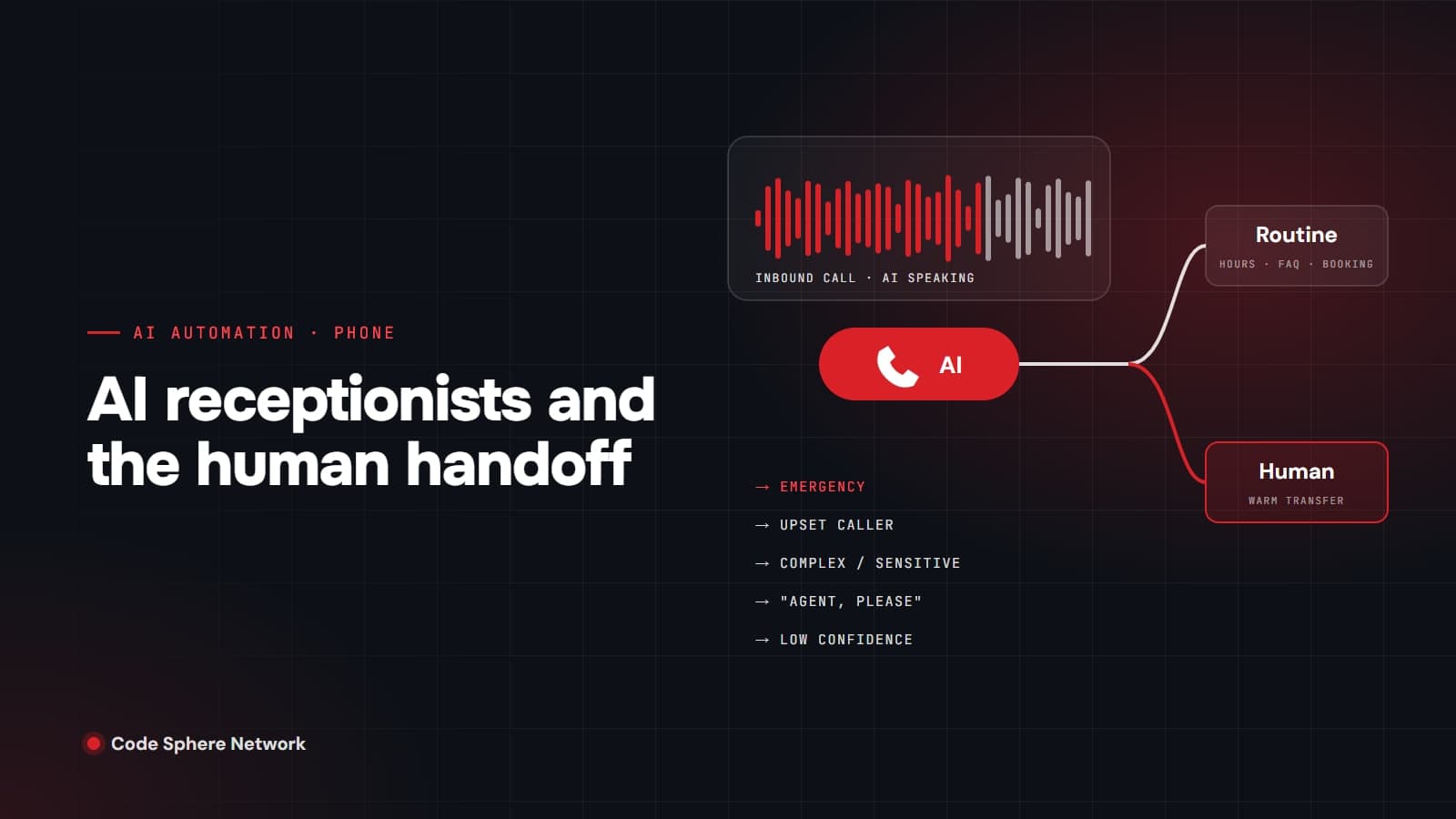
Short answer: yes, an AI receptionist can reliably answer routine business calls, such as questions about hours, directions, services and pricing, booking and rescheduling appointments, taking messages and routing callers to the right team. It should hand off to a human for emergencies, upset callers, complex or sensitive matters, anything that needs judgement, whenever the caller asks for a person, and whenever the AI is not confident in its answer. The handoff should be quick, keep the context of the call, and be designed in from the start rather than added later.
What an AI receptionist does well
Modern voice AI can hold a natural conversation, understand what a caller wants and act on it through your calendar, CRM or phone system. The calls it handles best are frequent, predictable and low-risk:
- Answering questions about opening hours, location, parking and services
- Booking, confirming, rescheduling and cancelling appointments
- Taking messages and creating a ticket or CRM record
- Qualifying new enquiries by capturing name, company, need and urgency
- Routing callers to the right person or department
- Covering after-hours and overflow calls so nobody reaches a full voicemail box
For a small office, the practical benefit is that every call is answered, even when the front desk is busy, and staff spend their time on the conversations that actually need them.
Where AI receptionists fall short
The main technical risk is that generative AI can sound confident while being wrong. The US National Institute of Standards and Technology lists this as "confabulation," describing it as when AI systems "generate and confidently present erroneous or false content," and notes that it is colloquially called hallucination. On a phone call, where the caller cannot see a source, a confident wrong answer about a price, a policy or an appointment time can do real damage.
The other limit is human. Callers who are frustrated, grieving, anxious or dealing with something unusual need empathy and discretion, and they notice quickly when they are not getting it.
When the AI should hand off to a human
Build these triggers into the system from day one:
- Emergencies. If a caller describes a situation needing police, fire or an ambulance, the AI should tell them to hang up and call 9-1-1 immediately. E-Comm 9-1-1 in British Columbia describes 9-1-1 as being "for emergencies that require immediate help from police, fire or ambulance." For urgent business issues, such as a client whose systems are down, route straight to your on-call person.
- The caller asks for a person. Honour it straight away, without making them repeat the request three times.
- Frustration or distress. Raised voices, repeated rephrasing or phrases like "this isn't helping" should trigger a transfer.
- Complex, high-value or sensitive matters. Complaints, billing disputes, legal or medical questions, large quotes and anything involving personal hardship belong with a person.
- Low confidence. If the AI cannot find an approved answer, it should say so and transfer or book a callback rather than improvise.
- Identity or account changes. Requests to change payment details or account access need proper verification by a person.
Research on customer attitudes supports this approach. In a 2024 Gartner survey of 5,728 customers, 64% said they would prefer companies did not use AI in customer service, and the top concern was that it would become harder to reach a person. A 2026 Gartner survey of 3,566 customers found that 87% say it is essential for companies using generative AI to provide an option to reach a human agent. Gartner's advice to service leaders is that AI should attempt a resolution "only when confidence is high, with a clear path to human support."
Designing a good handoff
How the handoff works matters as much as when it happens.
- Use a warm transfer where you can. In contact-centre terms, a warm transfer passes the call to a colleague with an explanation of why it is being transferred, while a cold or blind transfer does not. With a warm transfer, the caller does not have to start again.
- Pass the context along. The person picking up should see the caller's name, reason for calling and what the AI has already collected.
- Have a fallback when nobody is free. Offer a guaranteed callback time, take a detailed message, or page the on-call person after hours. Do not leave a caller in a queue with no end.
- Tell the caller what is happening. Gartner's 2024 guidance says AI should let customers know it will connect them to an agent if it cannot provide a solution.
Tell callers they are speaking with AI
Canada does not yet have a law in force that specifically regulates AI receptionists. Bill C-27, which included the proposed Artificial Intelligence and Data Act, died when Parliament was prorogued in January 2025, and a new privacy bill, C-36, was introduced in June 2026 and is still before Parliament.
The expectation is clear all the same. Canada's federal, provincial and territorial privacy regulators, including BC's, published principles for generative AI in 2023 that say where a tool is public-facing, people using it should be "aware that they are interacting with a generative AI tool." The federal Voluntary Code of Conduct for advanced generative AI systems makes a similar commitment: systems that could be mistaken for humans should be clearly identified as AI. Open every call with a short, friendly disclosure, such as "You're speaking with our virtual assistant," and callers can decide how to proceed.
Recording, transcripts and privacy
Most AI receptionists record or transcribe calls in order to work, which brings privacy law into play.
- Say that the call is recorded, and why. The Office of the Privacy Commissioner of Canada says organizations "must inform the customer that they are recording a call, clearly state the purpose of the recording and ask for their consent." A vague "for quality purposes" line is not enough if recordings are also used for something else, such as marketing.
- Offer an alternative. If a caller does not want to be recorded, the OPC says they should be offered another way to do business, such as visiting in person, writing, or completing the transaction online.
- Keep recordings and transcripts only as long as you need them. The regulators' AI principles call for retention schedules that cover AI prompts and outputs. There is no single mandated period; set one that matches your stated purpose.
- Stay accountable for your vendor. PIPEDA does not prohibit sending personal information to a provider outside Canada for processing, but the OPC is clear that the organization "is accountable for the information" once it transfers it to a service provider. BC's Information and Privacy Commissioner has made the same point about AI tools in healthcare: an organization cannot avoid its obligations under PIPA by contracting with another organization. Know where your provider stores call data and what it does with it.
- Be careful with voice identification. The OPC's biometrics guidance treats voice as biometric information and says a generic "this call may be recorded for identification purposes" statement would generally not be valid consent for creating voiceprints.
Keep the AI to approved answers
The best way to reduce confident mistakes is to limit what the AI is allowed to say. Give it a curated knowledge base covering your services, hours, policies and prices. Tell it to transfer, rather than guess, when a question falls outside that knowledge. Review a sample of transcripts every week, and update the knowledge base when you find a gap.
How to measure whether it is working
- Containment or self-service rate: the share of calls fully handled without a person. Higher is not always better; containing a call that should have been transferred is a failure.
- Transfer rate and reasons: why calls go to humans, which shows what to automate next and what never to automate.
- Resolution rate: whether the caller's need was actually met.
- Caller satisfaction and complaints, including a quick check of calls that ended abruptly.
- Missed-call rate before and after launch.
A negative first experience is costly. In Gartner's 2026 research, only 27% of customers said they would be willing to try a chatbot again after a negative experience. That makes a careful launch, with conservative handoff rules that you loosen over time, the safer path.
Inbound answering is different from outbound AI calling
Everything above is about answering calls people make to you. Using AI to place outbound calls, such as reminders, surveys or sales calls, is a different situation. Canada's Unsolicited Telecommunications Rules, which include the Telemarketing Rules and the Automatic Dialing-Announcing Device (ADAD) Rules, govern telemarketing and automated calls, and the ADAD rules also contain provisions for calls that are not telemarketing. Check those rules before switching on any outbound AI calling.
How Code Sphere Network builds AI receptionists
Our AI automation team builds AI receptionists and voice agents trained on your real services, policies and tone, with handoff rules, CRM integration and weekly tuning after launch. Because we also run business phone systems, we can connect the AI to your existing numbers, hunt groups, IVR and after-hours routing, so a transfer to a human actually reaches one. Book a free consultation to map which of your calls an AI should answer, and which it should always pass to your team.
Sources
- NIST AI 600-1: Artificial Intelligence Risk Management Framework, Generative AI Profile
- E-Comm 9-1-1: Calling 9-1-1
- Gartner: Survey finds 64% of customers would prefer that companies didn't use AI for customer service (2024)
- Gartner: 87% of customers say companies using GenAI for customer service must provide access to a human agent (2026)
- Gartner: Only 27% of customers would try a chatbot again after a negative experience (2026)
- Genesys: Warm transfer (glossary)
- Genesys: Cold transfer (glossary)
- Parliament of Canada, LEGISinfo: Bill C-27 (44th Parliament)
- DLA Piper: Canadian privacy and AI horizon shifts again (January 2025)
- Parliament of Canada, LEGISinfo: Bill C-36 (45th Parliament)
- Office of the Privacy Commissioner of Canada: Principles for responsible, trustworthy and privacy-protective generative AI technologies
- ISED: Voluntary Code of Conduct on the Responsible Development and Management of Advanced Generative AI Systems
- Office of the Privacy Commissioner of Canada: Recording of customer telephone calls
- Office of the Privacy Commissioner of Canada: Guidelines for processing personal data across borders
- OIPC BC: PIPA and AI scribes, best practices for healthcare organizations
- Office of the Privacy Commissioner of Canada: Guidance for processing biometrics, for businesses
- Microsoft Learn: Measure and improve agent performance with KPIs and analytics
- Government of Canada, National DNCL: Telemarketer FAQs
About Code Sphere Network Team
Code Sphere Network Inc. is a Vancouver-based managed IT, cybersecurity, cloud and AI automation provider serving businesses across Canada. Our team writes these guides from the work we do for clients every day.
